• Getting It Right • Paradox Theory
• Assessment Process • Assessment and Selection
• Candidate / Employee Reports
Getting It Right
We have chosen to partner with Harrison Assessments because its whole approach, depth of thinking, methodology and extent of assessment analysis, are exceptional.
Its unique, fully customisable, integrated assessment technologies identify and measure core behavioural competencies in depth, it is widely proven to accurately predict job performance, and pinpoints key factors for effective employee recruitment, work satisfaction, talent development and retention strategies.
-
the assessment is job focused
-
there is just one assessment questionnaire, which is used for all aspects of talent management
-
it takes less than 30 minutes to complete
-
there are research-validated key job success factors for each specific job
-
this results in a highly accurate prediction of job success
-
job specifications are highly customisable
-
reports provide detailed, in-depth insights addressing all job-related traits of the assessed person, including powerful Paradox analysis
Paradox Theory
In order for employees to prosper and be productive in a particular job, it is essential that they possess the traits that produce success in that job and fit the culture of the company. Assessing those traits requires a system that reveals deep insights into human behaviour.
Most behavioural assessment systems rely on a traditional bipolar either/or relationship between traits. However, this strongly limits the possibility of fully understanding an individual’s behaviour range in different situations. For example, with Diplomatic and Frank, the bipolar approach assumes that the more Diplomatic you are, the less Frank you are and vice versa. This is not correct, you can be both Frank and Diplomatic or neither.
Harrison takes a different approach, based on Paradox Theory, which measures each of complementary traits independently, to gain clear insight into how a person manages important work situations. According to Paradox Theory, a trait can be either constructive or destructive depending upon other complementary traits.
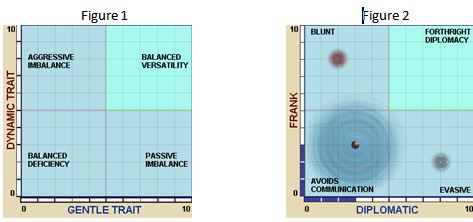
For example, when frankness is complemented by diplomacy, it takes the constructive form of being forthright and truthful. However, without the complementary trait of diplomacy, frankness becomes bluntness. On the other hand, Diplomacy is also normally a positive trait, but without Frankness, it can be counter-productive, taking the form of evasiveness.
This depth of information is critical for making the right hiring decisions and optimising the performance of your existing employees.
Paradox Theory focuses on analyses the 12 paradox pairs that are shown to have the most influence on good job performance and they are presented in a graphical view of a person’s tendencies. Within each Paradox, there are two complementary (paradoxical) traits, one a ‘dynamic’ trait such as frankness, while the other is a ‘gentle’ trait such as diplomacy. The relationship between each of the 12 pairs of dynamic and gentle paradoxical traits is portrayed on an XY graph.
Each graph area is divided into four quadrants as shown in Figure 1. Figure 2 is a sample paradox relating to frankness and diplomacy.
-
Balanced Versatility – both traits are strong and thus manifest their constructive aspects
-
Aggressive Imbalance – the dynamic trait is strong and the gentle trait is weak, indicating a tendency to be overly aggressive
-
Passive Imbalance – the gentle trait is strong and the dynamic trait is weak, indicating a tendency to be overly passive
-
Balanced Deficiency – both traits are weak, indicating a deficiency of both of the paradoxical traits
An example of all twelve paradox graphs is shown below. A Paradox report explains the traits for each paradox and the results shown.

Assessment Process
Individuals complete a single questionnaire only and the results of this are used for all assessment needs – recruitment, development, identifying high potential, leadership, employee career planning, talent pipeline and succession planning. Together with highly automated processes, this saves considerable time and cost in talent management, whilst providing constant ‘real time’ data.
The same assessment process is used for both talent recruitment and talent development.
- The methodology is job-centric and revolves around a defined evaluation of the key job success factors related to a specific position in your company (a Job Success Formula or JSF)
- the assessment compares each person against the ideal profile of the JSF
- The JSF covers Eligibility (education, skills, relevant experience), Suitability (job behaviour assessment) and Interview
- Over 25 years of performance research is used to create validated JSFs for specific jobs, so eliminating the guesswork as to which behavioural factors relate to success in a particular job
- You can select from a library of over 6500 pre-configured JSFs and, with minimal effort, tailor your selection and weight the importance of each key factor, to create your customised JSF
- If you have undertaken High Performance Benchmarking for a job for which you are now hiring, then your benchmarking JSF will provide for a highly accurate prediction of job performance
- Including your selection of key traits, a total of 175 behavioural (Suitability) traits are evaluated during the assessment process
Assessment and Selection
The details below cover recruitment and also largely apply to existing employee assessment.
- A completely automated online process to the shortlist stage
- It starts with a straightforward sub-30 minute online questionnaire
- An Eligibility filter politely declines unqualified applicants early in the questionnaire
- Advanced cross-referencing technologies provide the equivalent information of a full day test completing 2,700 multiple-choice questions
- A lie detector system prevents attempts at deception
- Candidate/employee assessment scores are extensively proven to predict job performance
- A ranked list of qualifying candidates, including a top-candidates shortlist
- Rankings are automatically updated after each candidate assessment
- Ideal applicants are identified the moment they apply
- Leadership Potential of new recruits or existing employees is automatically identified by the assessment
- Competency-based interviewing – individually tailored interview questionnaire for each shortlist candidate
Candidate/Employee Reports
- The most detailed and informative recruitment candidate/employee reports in the industry
- Reports are specific to each person or team and to each specific job
- The suite of reports address recruitment, talent development, leadership and organisational development
- Some reports ‘overlap’ in that they are used for recruitment and development purposes
- Harrison Paradox Analysis provides managers with a deep insight into a job candidate or employee’s behaviours as they relate to a specific job. It is the only assessement system that applies paradox analysis
- The reports are dealt with in more detail under individual Service headings
Click Here to request a sample Recruitment or Development report